Printable Emergency Binder: A Disaster Preparedness Checklist for Your Family
Phones die, cell networks jam, and cloud accounts need a signal. Paper still works. This 13-page binder puts your plan, contacts, and records in one place you can grab on the way out.
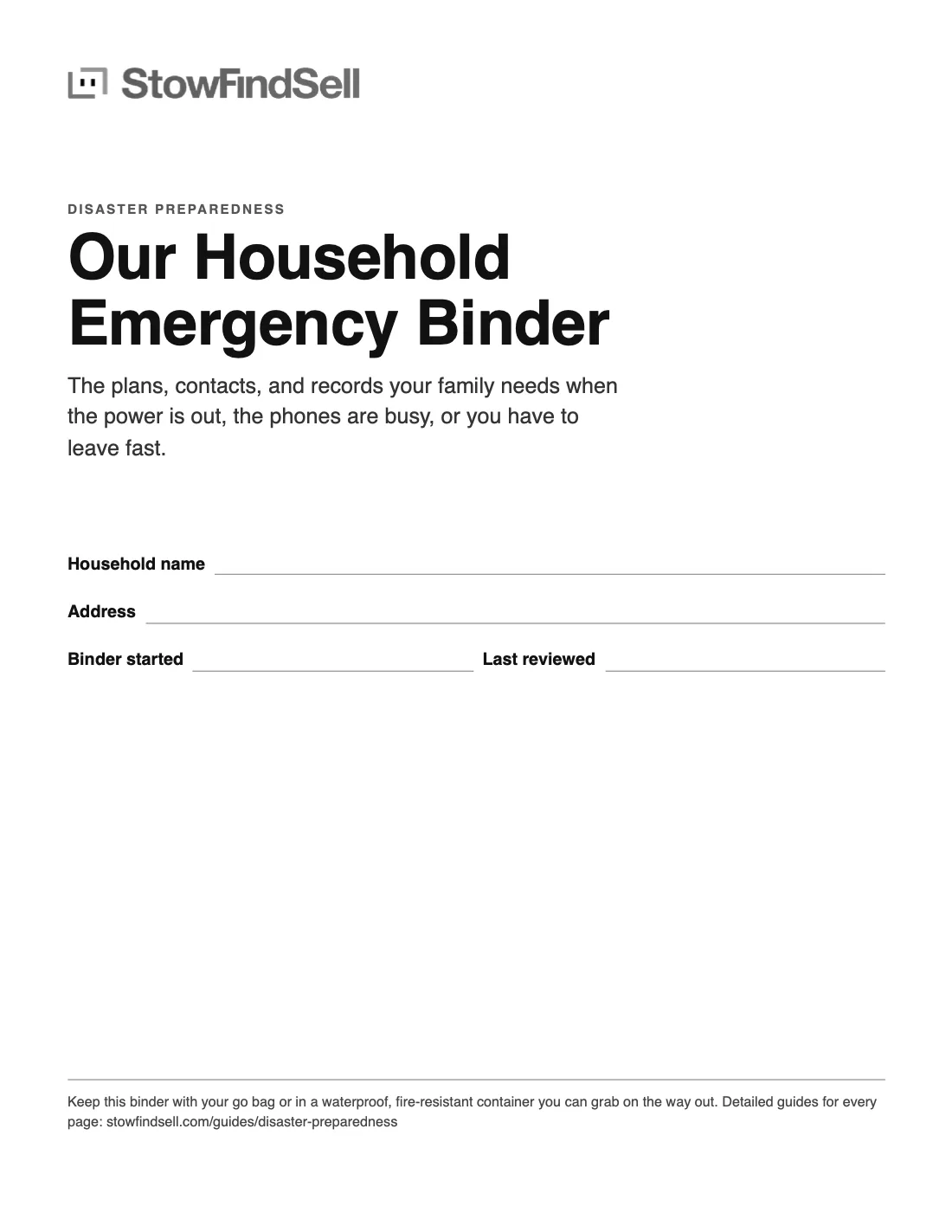
- Contacts and meeting places on paper, for when your phone isn't there
- A family code word plan to stop voice-cloning scams
- Documents, insurance, and home inventory pages for a faster claim
PDF, 13 pages, U.S. letter, prints in black and white. No sign-up needed.
What is an emergency binder?
An emergency binder is a printed folder that holds your family's emergency plan, contacts, and key records in one place. It works when phones are dead, networks are down, or you have to leave the house in a hurry.
Most families keep their emergency plan in their heads and their phone numbers in their phones. Both fail at the worst time. A binder makes the plan something everyone in the house can read, including a babysitter, a grandparent, or a neighbor who checks on the kids. Our disaster preparedness checklist explains each step in detail. This binder is where you write down your answers.
What should go in an emergency binder?
Start with phone numbers, meeting places, evacuation routes, and where your utility shutoffs are. Then add where your important documents are kept, a summary of your insurance, a go bag checklist, and a record of what you own.
Here's what each page of the printable binder covers:
- Who lives here. Names, medications, allergies, equipment, and pets with microchip numbers.
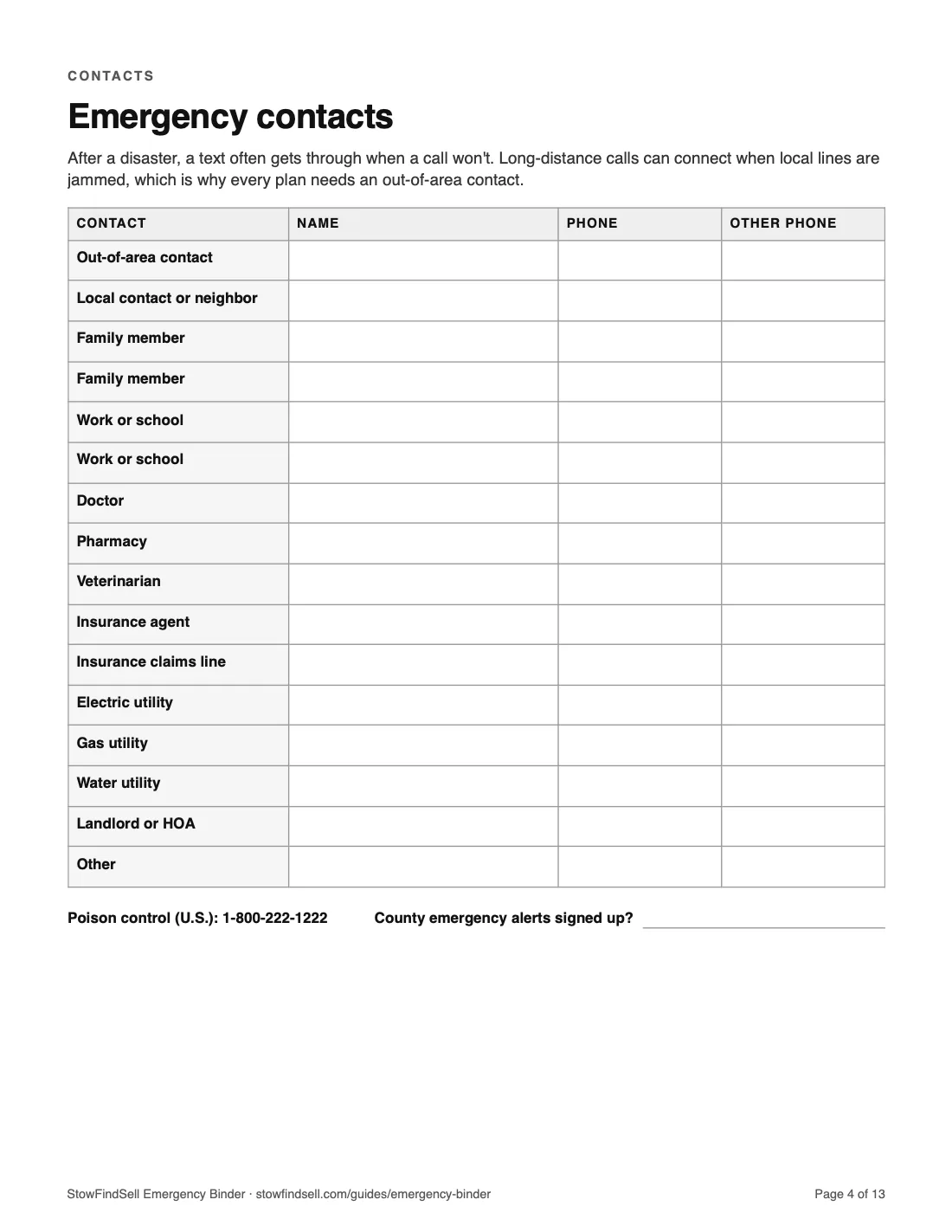
- Emergency contacts. An out-of-area contact, doctors, insurer, utilities, and neighbors.
- Family code word. How to pick one, how to use it, and what to do when a call feels wrong.
- Meeting places and routes. Where to meet, two ways out, and space to sketch your escape plan.
- Utility shutoffs. Where the water, gas, and electric shutoffs are, plus gas safety basics.
- Important documents. Where each original is kept and where its copy lives.
- Insurance summary. Policies, deductibles, claims numbers, and the questions to ask before a disaster.
- Go bag checklist. Water, light, health, clothing, tools, money, and pet supplies.
- Home prep by risk. Key steps for house fire, wildfire, flood, hurricane, tornado, and earthquake.
- Home inventory summary. Your highest-value items and where your full inventory is kept.
- Review log. A twice-a-year checklist so the binder stays current.
Why does every family need a code word?
Scammers can now copy a person's voice from a short clip online and fake the number a call comes from. A secret word or phrase that only your family knows lets you check whether a panicked call for money is really from a relative.
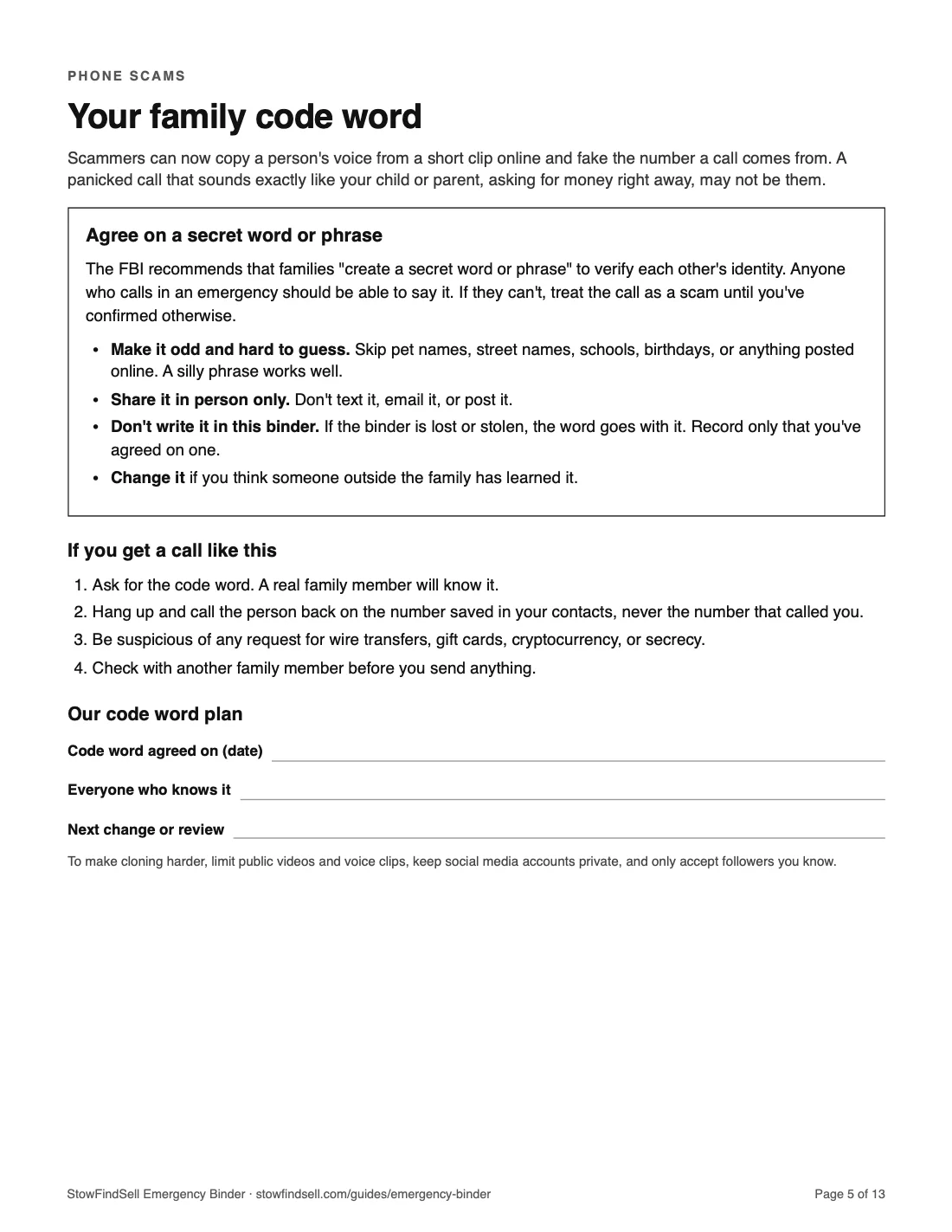
In a December 2024 public service announcement, the FBI warned that criminals use AI to clone voices for fake emergency calls, and recommended that families create a secret word or phrase to verify each other. A few rules make a code word work:
- Pick something odd. Skip pet names, street names, schools, birthdays, or anything you've posted online.
- Share it in person. Don't text it, email it, or post it.
- Keep it out of the binder. Write down only the date you agreed on it and who knows it.
- Call back. If a call feels wrong, hang up and call the person on the number saved in your contacts, never the number that called you.
It also helps to limit public videos and voice clips, keep social media accounts private, and only accept followers you know.
Which documents belong in an emergency binder?
Note where you keep IDs, passports, birth and marriage certificates, insurance policies, deeds or leases, vehicle titles, medical records, wills, and recent tax returns. Keep originals in a waterproof, fire-resistant container and copies off-site, and write down where each one is rather than the numbers on it.
The documents page lists 15 common records, plus a blank row, with columns for whether you have it, where the original is, and where the copy is kept. The insurance page goes one step further: it asks the questions people usually learn the answers to after a disaster, like whether flood is covered, what a wind or hurricane deductible is in dollars, and whether contents are paid at replacement cost or actual cash value.
The other record your insurer will ask for is a list of what you owned. The binder has a page for your highest-value items and for where your full inventory lives. StowFindSell is home inventory software that runs in your phone's browser and keeps that list in the cloud, with photos, values, and serial numbers, and exports a Proof Pack when it's time to file. See how to create a home inventory for the room-by-room method.
Where should you keep your emergency binder?
Keep it with your go bag or in a waterproof, fire-resistant container near an exit, so you can grab it on the way out. Give a copy of the contacts and meeting places pages to your out-of-area contact.
The binder holds private information, so treat it like a wallet. Don't leave it in the car, shred old pages when you replace them, and never write passwords or full bank or card numbers in it. Review it twice a year: update phone numbers, swap expired supplies, and make sure everyone still knows the code word.
Prepare for the risks where you live
The home prep page sums up the key steps for six common risks. For the full version, read the guide for each one:
- How to prepare for a house fire
- How to prepare for a wildfire
- How to prepare for a flood
- How to prepare for a hurricane
- How to prepare for a tornado
- How to prepare for an earthquake
Frequently asked questions
Do I need to give my email to download the binder?
No. The PDF downloads straight from this page, with no sign-up.
Can I print the binder at home?
Yes. It's 13 pages, sized for U.S. letter paper, and designed to print in black and white.
Should I write my family code word in the binder?
No. If the binder is lost or stolen, the word goes with it. Record only the date you agreed on one and who knows it, and share the word itself in person.
What should I do if I get a call from a relative asking for money?
Ask for the code word, then hang up and call them back on the number saved in your contacts. Be suspicious of any request for wire transfers, gift cards, cryptocurrency, or secrecy.
How often should I update my emergency binder?
Review it twice a year, such as when the clocks change, and whenever your household changes. The last page is a review log with a short checklist.
Should I keep digital copies of my documents too?
Yes. Keep digital copies in password-protected cloud storage, so you still have them if the house and the binder are both lost.
Print it this weekend
Fill in one page at a time, then put the binder somewhere you can grab it on the way out.
Download the printable PDFKeep your inventory where a disaster can't reach it
Photograph each room, add values and serial numbers, and export a Proof Pack when you need it.